
Carta Mobile
Empowering employees to accept grants, track vesting, exercise options, and manage their equity on the go.
Overview
Most people's first encounter with equity is confusing. You join a startup, sign some paperwork, and somewhere in there you own a small, theoretical slice of the company. Carta Mobile is where employees at thousands of companies find out what that means and act on it: accept the grant, watch it vest, exercise when it's time.
I supported the app for seven years, from a read-only window into Carta to a place people move real money. It holds a 4.8★ rating on the App Store.


The app’s one-line brief.
Sign-in, light.
Sign-in, dark.
Where it started
I joined Carta through its acquisition of the Kik team, to build the mobile design practice. Carta's web product is built for admins: dense, powerful, oriented around the people running the cap table. The mobile app served the other side, and when I started it was a window you looked through. You could see your grants. You couldn't do much about them.
The people on that side don't log in every day. The employee checking vesting on the train, the early hire wondering what the shares might be worth, the ex-employee deciding whether to exercise before a deadline. They log in when something is happening, and every session carries some weight.
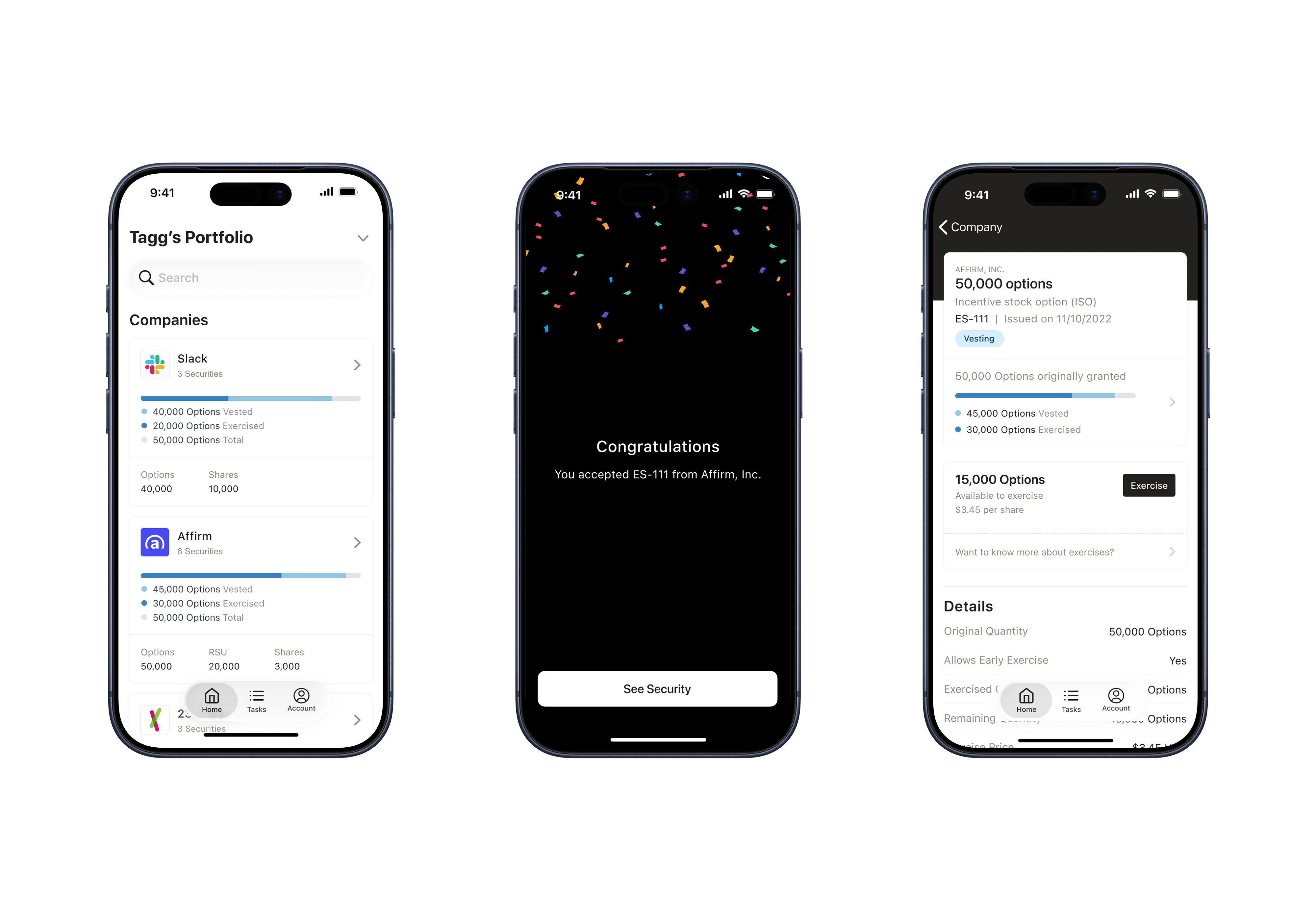
Accepting a grant, then the grant itself: vesting, and the option to exercise.
The design challenge
Equity is one of those topics where the complexity is the product. Vesting schedules, exercise windows, strike prices, fair market value: you can't flatten it into a single number without losing something important, and you can't dump a spreadsheet onto a phone and call it done. The job was finding the line between clarity and completeness for people checking between meetings, not at a desk with a calculator.
Exercising was where that line mattered most. Employees who could exercise often didn't. Plenty didn't realise that an option is only the right to buy shares, and that exercising is the purchase itself: real money out, and a tax bill that arrived as a surprise. The fear wasn't of the money. It was of not understanding the money. So instead of a shorter form, we built the understanding into the flow: plain explanations at the point the question comes up, and a simulator that models the outcome and the taxes before anyone commits a dollar.
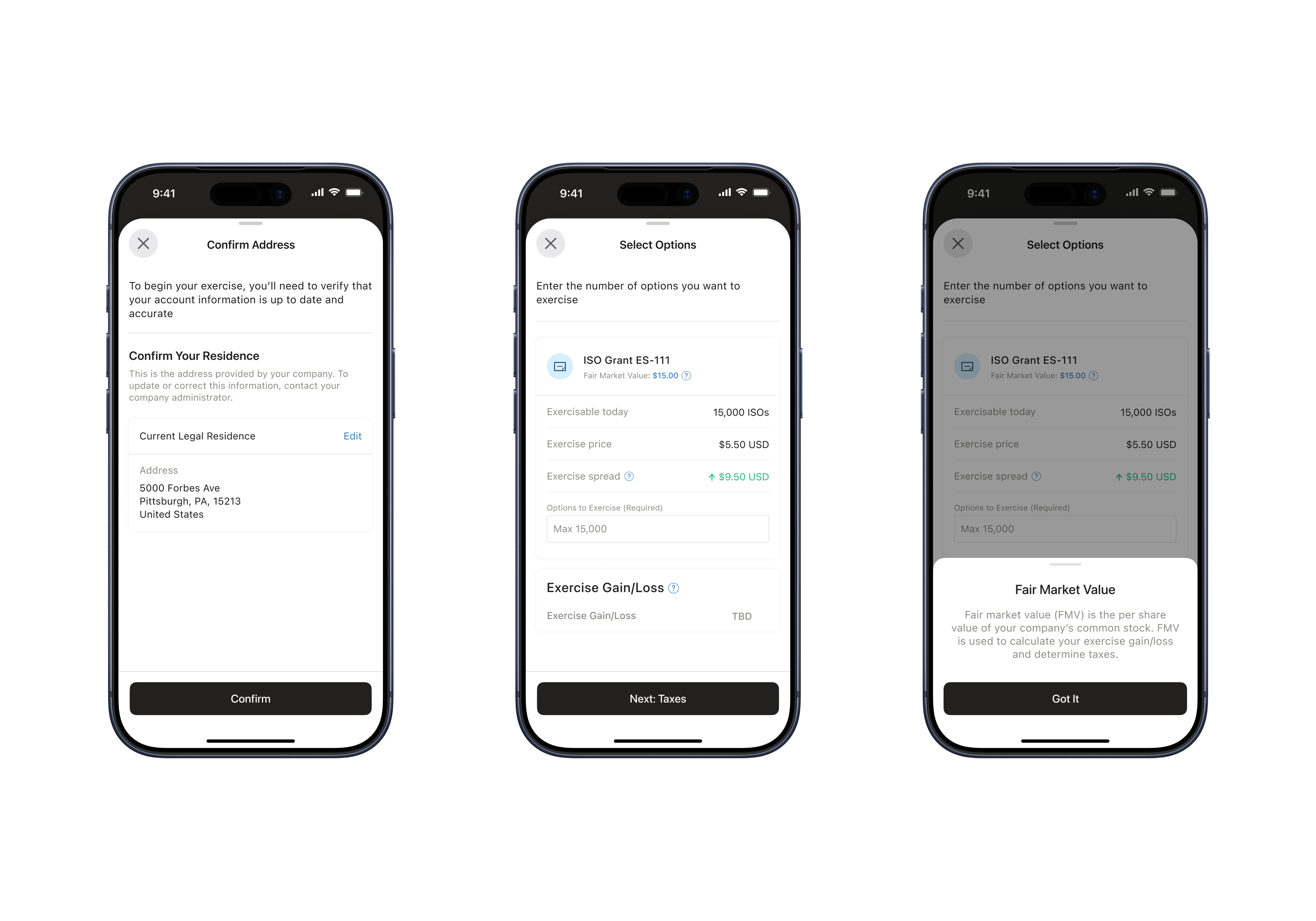
Exercising: confirm residence, choose how many options, and fair market value explained where the question comes up.
What it grew into
Over time the app went from a read-only window into Carta to a place where people do things: accept grants, simulate an exercise, exercise, track holdings across currencies. Each release closed a gap between what the phone showed and the decision someone needed to make. The through-line stayed the same: meet people where they are, not where a finance team assumes they are.

Carta on the home screen.

The exercise approved, on the lock screen.
Outcome
- Monthly exercise volume went from roughly $5M to between $10M and $20M within three to four months of the new flow shipping. Completion and drop-off on the flows I owned improved directly.
- Tens of millions of dollars in options now get exercised from a phone, across thousands of companies.
- 4.8★ on the App Store.
Internal Carta metrics. Volume totals are shared credit with the team.
What I learned
Trust is load-bearing in a financial product. When someone is looking at a number that is a real chunk of their net worth, every detail matters: the alignment of decimal points, the copy on the confirmation button, the freshness of the data. People feel uncertainty in an interface before they can name it, and here uncertainty is what makes someone close the app and open a laptop. The simulator taught me the cheapest way to earn that trust: let people rehearse the decision before they make it.